Agentic AI on WhatsApp Cloud API (2026): The Complete Guide to Autonomous Customer Support, Smart Broadcasting & E-Commerce Automation
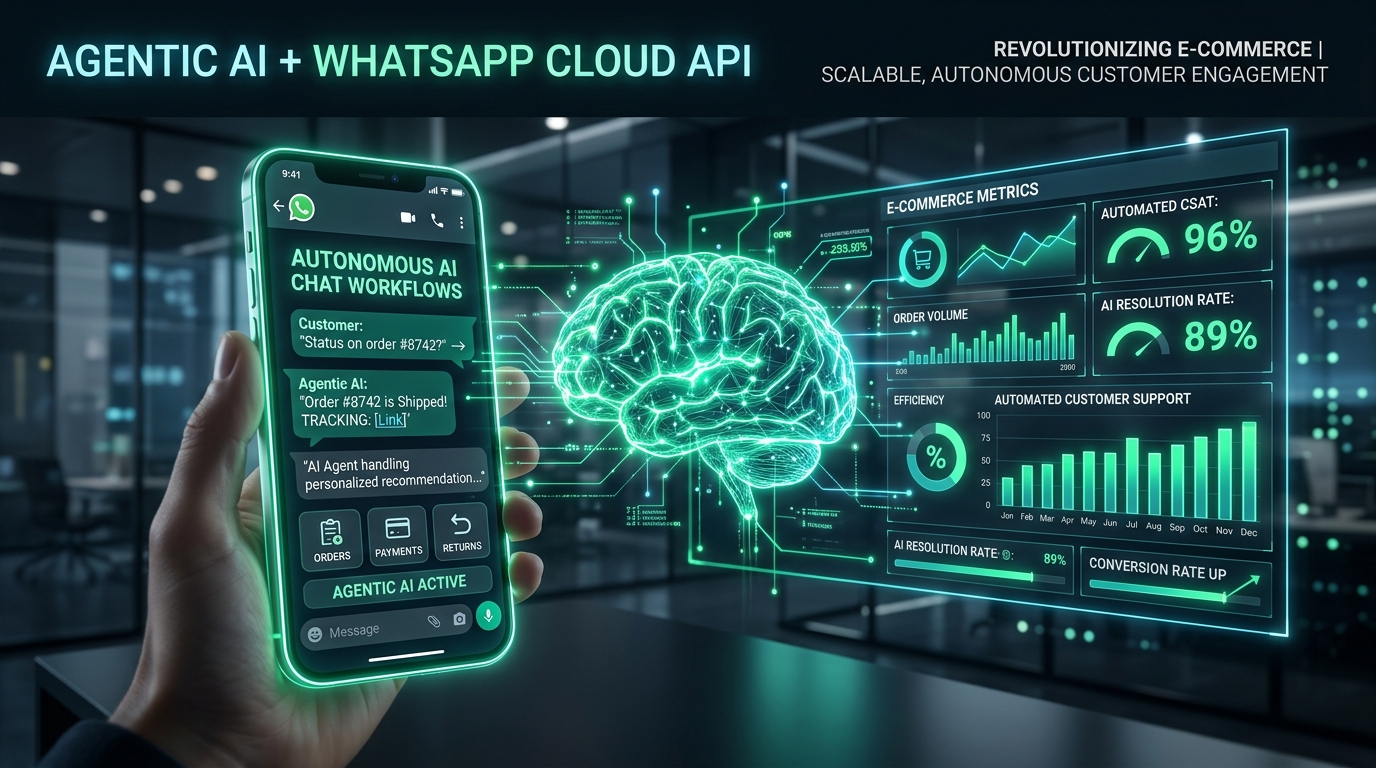
The era of rigid, decision-tree chatbots and repetitive keyword responders is officially over. As e-commerce brands navigate surging customer acquisition costs, tightening Meta compliance standards, and round-the-clock shopper expectations, Agentic AI paired with the WhatsApp Cloud API has emerged as the definitive breakthrough of 2026. Unlike legacy bots that merely deflect inquiries with static links, autonomous AI agents reason across multiple systems, interact directly with store backends, execute actions in real time, and deliver seamless conversational commerce without human intervention.
Whether you manage a fast-scaling Shopify storefront, a global WooCommerce catalog, or a high-volume D2C brand, deploying autonomous agentic workflows on WhatsApp allows you to achieve 90%+ first-contact resolution rates, conquer the notorious "6 PM support bottleneck," and turn your WhatsApp channel into a high-converting revenue driver. In this definitive guide, we explore how Agentic AI operates under Meta's Cloud API architecture, unpack core e-commerce workflows, compare legacy bots against modern AI agents, and provide an actionable roadmap to deploy autonomous support on your store today.
What is Agentic AI on WhatsApp Cloud API?
To understand the power of Agentic AI, one must first recognize why traditional e-commerce chatbots consistently disappoint consumers. For years, businesses relied on rule-based chatbots—mechanisms that force customers down predetermined menus ("Reply 1 for tracking, Reply 2 for returns"). When a customer asked a nuanced question like "I ordered the midnight blue hoodie yesterday under order #8742, can I change the size to Large before it leaves the warehouse?", the bot would inevitably fail, triggering frustrating loops or delayed human ticketing queues.
Agentic AI represents a fundamental architectural evolution. Instead of simply predicting text or matching keywords, an Agentic AI system possesses four core cognitive components:
- Perception & Intent Parsing: Understanding complex, multi-sentence customer intents across text, voice notes, and uploaded photos in 50+ languages using frontier Large Language Models (LLMs) like Google Gemini.
- Contextual Reasoning: Analyzing customer intent against live merchant policies, past purchase history, order statuses, and real-time inventory levels.
- Autonomous Tool Execution (Function Calling): Connecting directly to store APIs (Shopify, WooCommerce, ERPs, logistics couriers like Delhivery, Shiprocket, or FedEx) to query databases, update orders, apply discounts, or generate shipping labels autonomously.
- Memory & Multi-Turn Governance: Maintaining deep conversational memory across sessions while adhering to strict business rules, price thresholds, and security boundaries.
When powered by the Meta WhatsApp Cloud API—which handles enterprise throughput up to 500 messages per second with 99.99% uptime—Agentic AI becomes an always-on, autonomous workforce capable of handling thousands of simultaneous customer conversations effortlessly.
Why Meta's 2025/2026 Policy & Architecture Shifts Require Agentic Precision
The transition to Agentic AI is not just a technological luxury; it is an economic necessity driven by Meta's latest WhatsApp Business Platform structural changes:
1. Deprecation of On-Premises API
With the official deprecation of the legacy On-Premises WhatsApp Business API, all brands must operate on Meta's WhatsApp Cloud API. The Cloud API eliminates server maintenance overhead, delivers sub-second webhook latency, and provides native support for rich interactive elements including WhatsApp Flows 2.0, carousel templates, and native payment prompts.
2. Meta's Task-Specific AI Compliance Mandate
Meta's messaging policies strictly enforce that AI assistants operating on WhatsApp Business numbers must be task-specific and grounded in verifiable business functions. Unconstrained, generic conversational bots risk rate limits or phone number restrictions. Agentic architectures like Kwickbot are designed specifically around task-oriented function calls (order lookup, exchange processing, COD confirmation), ensuring 100% compliance with Meta guidelines.
3. Per-Message & Consumption-Based Economics
Meta's modern billing structure emphasizes message efficiency over drawn-out chat threads. An inefficient bot that requires 6 fragmented exchanges to answer a question incurs higher costs and erodes user satisfaction. Kwickbot's Agentic AI delivers consolidated, single-turn responses with interactive action buttons, cutting message consumption and maximizing return on ad spend (ROAS).
Top 5 High-Impact Autonomous Workflows for E-Commerce Brands
How does Agentic AI translate into measurable revenue and cost reductions on the ground? Here are the top five autonomous workflows driving exponential ROI for D2C brands in 2026:
1. Autonomous WISMO ("Where Is My Order") & Real-Time Logistics Tracking
WISMO queries account for 40% to 60% of all e-commerce customer support volume. Rather than sending a generic courier link that forces customers off WhatsApp, Kwickbot's AI agent:
- Authenticates the customer's phone number against active Shopify/WooCommerce orders.
- Pings courier APIs (e.g., Shiprocket, Delhivery, Blue Dart, FedEx) via real-time webhooks.
- Returns a crystal-clear, consolidated status update with live location coordinates, current transit milestone, and expected delivery date.
- Presents interactive quick-reply buttons (e.g., "Update Delivery Address", "Reschedule Delivery", "Speak to Human").
The entire inquiry is resolved in under 3 seconds in a single conversational turn.
2. Cash-on-Delivery (COD) Confirmation & Return-to-Origin (RTO) Shield
In key e-commerce markets such as India, the Middle East, Southeast Asia, and Latin America, COD orders suffer from high Return-to-Origin (RTO) rates—costing merchants up to 25% of top-line revenue in unrecoverable reverse logistics fees.
Kwickbot automates an intelligent RTO Shield:
- The moment a COD order is placed, Kwickbot triggers an automated WhatsApp template featuring interactive [Confirm Order] and [Cancel Order] buttons.
- If the customer confirms, the order is tagged as
COD-Confirmedin Shopify and released to the fulfillment center immediately. - If the customer has address typos or requests a delivery date change, the AI updates the shipping details directly via Shopify GraphQL API.
- This single autonomous workflow routinely slashes RTO rates by 30% to 45%.
3. Intelligent Abandoned Cart & Checkout Recovery Sequences
Standard email cart recovery achieves dismal 10-15% open rates. WhatsApp delivers 98% open rates and 45%+ engagement rates. However, blasting generic coupon codes feels spammy and damages brand equity.
With Kwickbot Agentic AI:
- The AI monitors abandoned checkouts via real-time webhooks.
- Within the optimal 30-to-60-minute window, it sends a personalized reminder displaying the exact product titles and variants left in the cart.
- When the customer responds with hesitation ("Is this fabric machine washable?" or "Do you have size XL in stock?"), the AI instantly resolves the product inquiry using store knowledge bases and generates a 1-tap pre-filled checkout link with a dynamic time-sensitive discount.
4. Conquering the "6 PM Support Bottleneck"
Data shows that over 42% of high-intent e-commerce shopping and support queries occur between 6:00 PM and midnight, as well as during weekends when internal human support agents are off-duty. Leaving these shoppers waiting until morning leads to abandoned carts, negative reviews, and lost sales.
Kwickbot's Agentic AI provides tireless 24/7/365 coverage. It answers complex technical specifications, assists with sizing guides, checks inventory in real time, and initiates warranty registrations without ever taking a day off.
5. Automated Exchange & Returns Processing
Handling reverse logistics manually consumes dozens of human agent hours each week. Kwickbot's AI agent guides the shopper through a frictionless, self-service return or exchange flow directly within the chat:
- Verifies return window eligibility according to merchant policy.
- Prompts the customer to select the return reason from an interactive dropdown.
- Allows the customer to upload an image of the item directly in WhatsApp to assess condition.
- Initiates reverse pickup via logistics integration and creates an exchange order in Shopify automatically.
Strategic Comparison: Rule-Based Chatbots vs. Traditional AI vs. Kwickbot Agentic AI
| Capability / Feature | Rule-Based Chatbots | Basic AI Chatbots | Kwickbot Agentic AI Platform |
|---|---|---|---|
| Core Architecture | Rigid keyword trees & numeric menus | Generic LLM prompt wrappers | Autonomous Reasoning Engine + Function Calling Tools |
| System Execution | None (sends static web links) | Read-only text answers | Bi-directional read/write sync (Shopify, ERP, Logistics APIs) |
| First-Contact Resolution Rate | 15% – 25% | 40% – 55% | 85% – 94% |
| Meta Compliance | Low engagement risk | High risk of policy breach (open-ended chat) | 100% Task-Specific compliance out of the box |
| Human Coexistence | Manual ticket assignment only | Bot often speaks over human agents | WhatsApp Coexistence 2.0 (auto-pauses when human replies) |
| Broadcasting & Attribution | Untargeted mass blasts | Basic scheduled campaigns | RFM-segmented broadcast scheduler + real-time revenue tracking |
AI-Driven Broadcasting & Click-to-WhatsApp (CTWA) Hyper-Growth
Autonomous AI agents do not merely react to incoming messages; they supercharge outbound marketing performance when integrated with Meta-approved broadcasting and paid acquisition campaigns:
Precision RFM Customer Segmentation
Blasting promotional messages to your entire subscriber list damages phone number quality scores and triggers customer opt-outs. Kwickbot automatically analyzes your store order history to build smart dynamic customer cohorts:
- VIP High-LTV Buyers: Exclusive early-access broadcasts for new product launches.
- Lapsed Churn-Risk Shoppers: Targeted win-back campaigns featuring dynamic incentives based on their last purchased category.
- Replenishment Cycles: Automated alerts sent 30 days after a consumable product purchase (e.g., skincare, nutritional supplements, coffee beans).
Exploiting the 72-Hour Free CTWA Window
One of Meta's most lucrative commercial opportunities is the 72-hour zero-fee conversation window for Click-to-WhatsApp (CTWA) ads. When a prospective buyer clicks an Instagram or Facebook advertisement leading to WhatsApp:
- Meta completely waives conversation charges for the subsequent 72 hours.
- Kwickbot's Agentic AI instantly engages the prospect with tailored product discovery questions.
- The AI guides them to checkout, answers pre-purchase objections, and recovers potential drop-offs—costing your brand zero Meta conversation fees while dramatically reducing blended Customer Acquisition Cost (CAC).
How Kwickbot Enforces Grounding & Safety Guardrails
For enterprise and D2C brand managers, the primary reservation about deploying generative AI is the fear of "hallucinations"—such as making unauthorized promises, quoting incorrect pricing, or giving invalid refund advice. Kwickbot solves this through a robust, four-tier governance architecture:
- Retrieval-Augmented Generation (RAG) with Live Store Knowledge: The AI references your indexed FAQ documents, store policies, and active Shopify product catalog. If an answer cannot be grounded in authenticated store data, it gracefully offers to connect the shopper with a human specialist.
- Strict Policy Thresholds: The AI can be restricted from issuing discounts above a predetermined percentage (e.g., max 15%) or approving refunds over a specific cart value without manager authorization.
- WhatsApp Coexistence 2.0: Support team members can view conversations and reply directly from their phone using the official WhatsApp Business app or WhatsApp Web. The instant a human sends a message, Kwickbot automatically silences the AI for that contact, preventing embarrassing overlapping replies.
- Super Admin Token & Usage Controls: Merchants set daily and monthly AI token ceilings to prevent runaway billing spikes during peak viral campaigns or flash sales.
5-Step Implementation Checklist: Deploying Agentic WhatsApp AI in 10 Minutes
- Connect Official WhatsApp Cloud API: Register your business phone number on Meta Business Manager and connect your Meta credentials inside Kwickbot in just two clicks.
- Integrate Your Shopify or WooCommerce Store: Link your e-commerce storefront to automatically synchronize product catalogs, inventory quantities, customer profiles, and order webhooks.
- Upload Store Policies & Knowledge Base: Import your return policies, shipping times, warranty details, and sizing guides via PDF, URL, or plain text to ground the Gemini AI model.
- Activate Automated Workflows: Toggle on one-click native recipes for COD verification, real-time WISMO tracking, abandoned cart follow-ups, and customer feedback collection.
- Launch & Track KPIs: Monitor your live analytics dashboard to track Autonomous Containment Rate, average resolution time, broadcast conversion rates, and attributed revenue.
Frequently Asked Questions (FAQs)
Q1: What is the primary difference between a chatbot and an Agentic AI agent?
A traditional chatbot follows rigid, pre-scripted decision trees and can only deflect users with static links. An Agentic AI agent understands natural language, reasons about customer context, and connects to your backend APIs (Shopify, ERP, logistics) to autonomously perform actions—such as retrieving live courier status, updating delivery addresses, processing returns, and applying dynamic discounts.
Q2: Does deploying Agentic AI require coding skills or developer resources?
No. Kwickbot provides a zero-code platform tailored specifically for e-commerce store owners. You can connect your WhatsApp Cloud API, integrate your Shopify or WooCommerce store, and configure AI agent behaviors through an intuitive visual dashboard without writing a single line of code.
Q3: How does Agentic AI comply with Meta's 2026 WhatsApp Business Platform policies?
Meta requires that AI bots on WhatsApp Cloud API be task-specific and grounded in concrete business workflows. Open-ended conversational bots are restricted. Kwickbot's AI is built specifically for outcome-driven commerce and support tasks (order tracking, product recommendations, COD verification), ensuring 100% compliance with Meta guidelines.
Q4: What happens if a customer inquiry is too complex for the AI to handle?
Kwickbot includes built-in WhatsApp Coexistence 2.0. If the AI detects sentiment escalation, a request for human assistance, or an unresolvable query, it seamlessly tags the ticket for human review and notifies your team. When a human representative replies via WhatsApp Web or mobile, the AI automatically pauses responses to avoid double messaging.
Q5: Can Agentic AI on WhatsApp handle multiple languages and voice notes?
Yes. Powered by Google Gemini AI, Kwickbot natively recognizes and responds in over 50 languages—including English, Hindi, Spanish, Arabic, Hinglish, and regional dialects—and can transcribe customer audio voice notes in real time to resolve inquiries effortlessly.